dri

Work Samples / Mike Griffin

The following work samples demonstrate some of the experience I've had in understanding users, translating that understanding into design concepts, and working with engineers to implement a functional system.


dri

AURA

As part of a usability team, I've been conducting formative studies to inform the design of an AI system called AURA. AURA is intended to serve as a Digital Aristotle, capable of answering scientific questions in multiple domains for researchers, educators and students. More about the Digital Aristotle »

>  
Design exploration, document-rooted interface
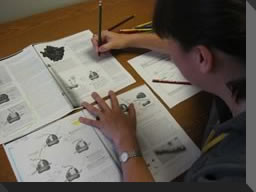
One requirement for the system is that all knowledge representations are linked to source documents, like textbooks. This linkage is intended to lend credibility and navigability to the system. Early on, it was clear that work needed to be done to specify how this linkage might be played out. To shed light on the design challenge, we carried out a study in which SMEs attempted to create links between source documents and knowledge representations, using paper mockups. We shared these results with the team and the client, and made a significant impact in clarifying the vision for the doc-rooted interface.
DRI17Mar04.ppt (2.1MB)

>  
User models and stories for design
We recently put together a number of user models, along with stories to concretize what we know about users, and to help clarify our assumptions about situations in which the system will be used. This framework has helped the team put its various technologies into a clearer single vision.
http://butterfly.ctl.sri.com/~griffin/aura/scenario/

TRAILS Gorp

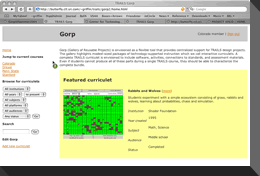
Gorp is a web application designed to support the learning of university students enrolled in technology design project courses. It allows students to document their design work as it progresses, helping team members appreciate each others' contributions, learn what's important in designing technology, come to a common understanding of the project vision, and communicate that vision to others. More about TRAILS »

We began the project with only a vague notion of what it would mean to build a lightweight application for this purpose. We spent a good deal of time exploring the idea, including brainstorming with technologists and instructors, observing course sessions at Stanford and Colorado, interviewing students and instructors, reviewing relevant secondary research. The design began to take shape in stories and accompanying UI sketches. Along the way, we confirmed our assumptions and priorities with instructors. After prototyping our design in a real class using a paper-based process, we implemented the application.

According to testimony of instructors and students, the system has been a clear success. The application is undergoing some UI refinements this summer before the next class sessions begin in the fall.

>  
Current implementation
http://trails-project.org/webapps/gorp/Gorp.do

>  
Mock-up of proposed improvements
http://butterfly.ctl.sri.com/~griffin/trails/gorp2/
http://butterfly.ctl.sri.com/.../home.html
http://butterfly.ctl.sri.com/.../colorado.html

kalie

Kalie's Test

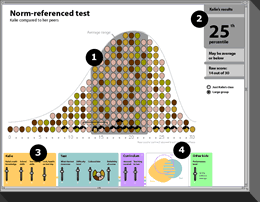
My Master's project at Stanford was a workshop that helped parents of middle school students learn to advocate for their children with regard to standardized testing. Central to the learning experience is a web-based interactive visualization that helps parents understand core concepts like percentile, as well as the way in which numerous factors interact to influence a child's scores. The workshop is currently being piloted by the Lawrence Hall of Science at UC Berkeley.

>  
Final report
This online report described the design of the project, and was my primary deliverable.
http://ldt.stanford.edu/~migri/kalie/report/

1